By now, the anxiety has a familiar shape. You open LinkedIn and see another colleague pivoting to "AI consulting." You read that 60% of professionals already use AI tools daily, yet 80% of them never received a single hour of formal training. You hear that entry-level positions have collapsed by 29% globally, while your manager casually asks if you've "tried Claude for that report."
The question is no longer whether AI will change your job. It's whether you'll be the one directing the tool — or the one whose tasks got absorbed by it.
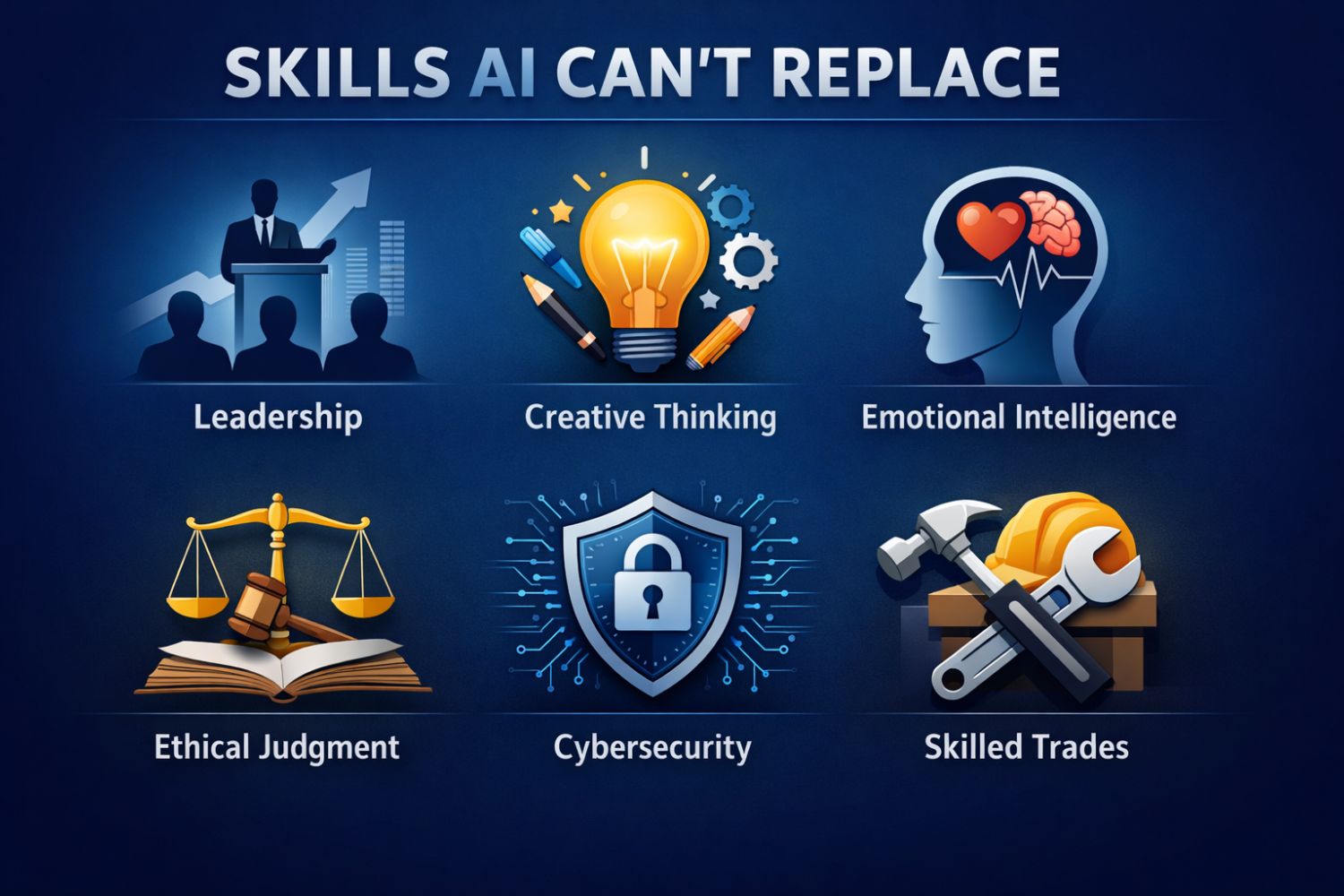
But here's what the panic headlines won't tell you: AI is not your replacement. It's your new coworker. And the workers who thrive in 2026 aren't the ones who know the most prompts. They're the ones who bring something to the table that no algorithm can replicate — judgment, creativity, empathy, and the discipline to keep learning.
This article is a field guide to building those skills. Not theory. Not hype. Just a clear map of what actually makes you irreplaceable, and how to develop it.
The State of Play in 2026: What the Data Actually Says
Before we talk about skills, let's ground ourselves in reality. The AI conversation has shifted from "Will robots take my job?" to "How fast is my job changing?"
| Metric | What It Means for You |
|---|---|
| 22% of all jobs will be disrupted by 2030 | Not eliminated — transformed. The WEF projects 170 million new roles created and 92 million displaced, yielding a net gain of 78 million positions. |
| 39% of core skills will change by 2030 | The skills you have today will be partially obsolete in five years. Continuous learning is no longer optional. |
| AI job postings up 144% year-over-year | US employers aren't cutting headcount — they're rewriting job descriptions. AI fluency is now a baseline requirement, not a bonus. |
| Workers with advanced AI skills earn 56% more | The wage premium is real and growing. But "advanced" doesn't mean "coding." It means integrating AI into judgment-driven work. |
| Only 26% of AI users say leadership has a clear strategy | Most companies are throwing tools at employees without redesigning workflows. This gap is your opportunity to lead. |
The danger isn't AI itself. It's standing still while the context around you shifts.
The Two Types of Professionals in 2026
Watch any office today and you'll see two distinct species emerging:
| The AI-Adjacent Professional | The AI-Dependent Professional |
|---|---|
| Uses AI to automate the routine, focuses on the complex | Uses AI to do the thinking, becoming a prompt-pusher |
| Questions AI outputs, applies judgment, adds context | Accepts AI outputs blindly, creates fragile work |
| Deepens human skills while layering on technical fluency | Neglects human skills, over-relies on tools |
| Becomes more valuable over time | Becomes replaceable over time |
The difference isn't intelligence. It's intentionality. The first group treats AI as a lever. The second treats it as a crutch.
JPMorgan understood this early. Rather than training 300,000 employees in narrow AI job titles, they taught practical skills: prompt construction, AI-assisted research, "maker/checker" workflows, and rigorous verification. The message was clear — AI applications vary across roles, but judgment is universal.
PwC's analysis of 500 million job adverts confirms this: roles using AI tools are seeing skills requirements change 25% faster, with wage premiums up to 25% — but only where workers integrate AI into daily tasks while applying strong human judgment.
The formula is simple: AI fluency + human judgment = premium. AI fluency alone = commodity.
The 5 Irreplaceable Skills (And How to Build Them)
The World Economic Forum, O*NET occupational research, and employer surveys consistently identify a set of capabilities that AI cannot replicate — even as language models and robotics reach impressive performance levels.
Here are the five that matter most in 2026, ranked by their protection rating and practical impact.
Skill #1: Complex Problem-Solving in Novel Contexts
WEF Protection Rating: 9.6/10
AI excels at problems it has seen before. It crumbles when the rules are undefined, the context is ambiguous, and the solution space is unknown. Crisis management, strategic pivots, unprecedented negotiations, diagnosing rare conditions — these require a human brain comfortable with uncertainty.
How to build it:
- Volunteer for stretch projects outside your comfort zone
- Study case studies in adjacent industries (not just your own)
- Practice "first principles" thinking: strip away assumptions and rebuild from zero
- Deliberately expose yourself to unstructured problems — the messier, the better
If you can define the problem when no one else can, you become indispensable.
Skill #2: Emotional Intelligence & Empathy
WEF Protection Rating: 9.4/10
AI can simulate empathy. It cannot feel it. And in contexts where the other person senses the difference — grief counseling, leadership, high-stakes negotiation, team conflict — the distinction is everything.
Research consistently shows that therapy, coaching, conflict resolution, and leadership effectiveness depend on genuine emotional attunement that no model can authentically provide.
How to build it:
- Invest in coaching or therapy — not because you're broken, but because emotional literacy is a skill
- Practice active listening without preparing your response
- Learn to read micro-expressions and body language
- Manage an AI-augmented team — knowing when to trust the tool and when to override it requires deep human judgment
Skill #3: Creative Originality & Vision
WEF Protection Rating: 8.9/10
AI generates content by recombining what it has seen. True innovation means connecting ideas in ways no dataset has mapped before. A new brand identity that shifts culture. A product that creates a market. A campaign that changes behavior. These require a human who understands why something would resonate, not just what has resonated in existing data.
How to build it:
- Build a creative practice outside work — writing, photography, music, cooking
- Develop and defend aesthetic opinions. Taste is a competitive advantage.
- Study fields far from your own. Innovation lives at the intersection.
- Create "impossible" briefs for yourself and solve them
AI can generate variations. Only you can generate vision.
Skill #4: Ethical Reasoning & Contextual Judgment
WEF Protection Rating: 8.5/10
AI applies rules. It cannot reliably make ethical judgments in contested situations. As AI proliferates, demand is surging for humans who can evaluate outputs for bias, fairness, legal compliance, and alignment with human values. From hiring algorithms to customer service bots to financial recommendations, someone has to make the call.
How to build it:
- Study AI ethics frameworks (EU AI Act, IEEE standards, organizational governance)
- Participate in cross-functional discussions about AI deployment
- Practice spotting bias in AI outputs — train your "red team" instinct
- Read philosophy and law. Ethical reasoning is a muscle, not a mood
Skill #5: Strategic Thinking & Long-Range Planning
WEF Protection Rating: 8.1/10
AI operates within defined objectives. Strategy requires questioning the objectives themselves. It means stepping back from current operations to ask: "What should we be doing?" This systems-level, purpose-setting thinking is where senior leaders differentiate themselves — and where AI is fundamentally blind.
How to build it:
- Read widely outside your domain (history, biology, economics, fiction)
- Practice scenario planning: map three possible futures for your industry
- Write strategy memos for hypothetical decisions — then test them
- Mentor others. Teaching forces you to articulate what you implicitly know
The "AI-Plus-Human" Skill Stack
The professionals winning in 2026 aren't choosing between human skills and AI fluency. They're stacking both.
Here's what that stack looks like in practice:
| Layer | Skill | What It Looks Like at Work |
|---|---|---|
| Foundation | AI literacy | You can use 3-5 tools relevant to your field, write clear prompts, and verify outputs |
| Structure | Workflow design | You embed AI into repeatable processes, creating templates and automation |
| Judgment | Critical evaluation | You fact-check, contextualize, and challenge AI-generated content |
| Differentiation | Human skills (the 5 above) | You bring creativity, empathy, ethics, and strategy that AI cannot |
| Multiplier | Continuous learning | You treat skill development as a habit, not an event |
The safest way to stay employable isn't to chase the latest AI job title. It's to build a stack of practical skills that compounds over time.
Cognizant's CEO Ravi Kumar put it bluntly: "Deep expertise will be less valued than people who combine domain knowledge with broad, adaptable AI fluency." The CFA Institute calls this "learnership" — using AI to learn faster, continuously update your skills, and critically evaluate what the models produce.
What the Research Says: The Skills That Pay
Let's move from theory to economics. PwC's data is unambiguous:
- Workers who pair AI fluency with strong human skills earn significantly more than peers who rely on one or the other
- Roles using AI tools see skills requirements change 25% faster — but also attract wage premiums up to 25%
- The fastest-growing skills in demand are: analytical thinking, creative thinking, resilience, flexibility, and leadership
Microsoft's 2026 Work Trend Index found that 58% of AI users say they're producing work they couldn't have completed a year ago. For "Frontier Professionals" — those most advanced in AI adoption — that figure jumps to 80%.
But here's the catch: organizational factors account for more than twice the variance in AI impact compared to individual skill. Culture, management support, and governance matter more than whether you know the perfect prompt. This means the professionals who can lead AI integration — not just use it — become the most valuable.
Your 90-Day Skill-Building Roadmap
Theory is useless without action. Here's a concrete plan:
Month 1: Audit & Foundation
| Week | Action |
|---|---|
| 1 | Audit your exposure. List which tasks in your job are pattern-based (AI-vulnerable) vs. judgment-based (AI-resistant). |
| 2 | Pick one AI tool. Learn it deeply relevant to your field. Don't chase every new release. |
| 3 | Start a "judgment journal." For one week, record every decision you made that AI couldn't have made for you. |
| 4 | Read one book outside your domain. Strategy, philosophy, psychology, or design. |
Month 2: Deepen Human Skills
| Week | Action |
|---|---|
| 5 | Take on a stretch project. Something ambiguous, cross-functional, and uncomfortable. |
| 6 | Practice emotional intelligence. Have three conversations where you listen 80% and speak 20%. |
| 7 | Build a creative habit. 30 minutes daily of writing, sketching, or problem-solving without AI assistance. |
| 8 | Study one AI ethics case. Understand where AI failed and why human judgment was needed. |
Month 3: Integrate & Lead
| Week | Action |
|---|---|
| 9 | Design one AI-assisted workflow. Document how AI handles the routine and you handle the complex. |
| 10 | Teach someone. Present your AI workflow to your team. Teaching forces mastery. |
| 11 | Write a strategy memo. Map three possible futures for your role or industry. |
| 12 | Evaluate and iterate. What's working? What's not? Adjust your stack. |
The Roles Most at Risk (And What to Do If You're in One)
Let's be honest. Some roles are being automated faster than others. If your job is heavy on the left side of this table, you need to act now:
| High Risk | Why | Your Move |
|---|---|---|
| Data entry / basic admin | Repetitive, structured, high volume | Move into data analysis, interpretation, or workflow design |
| Routine customer service | 70-80% of standard queries now handled by AI | Pivot to customer success, conflict resolution, or account management |
| Basic bookkeeping | Cloud AI handles reconciliation | Transition to financial advisory, strategy, or AI governance |
| Telemarketing / cold calling | Automated outreach outperforms | Move into relationship-based sales or strategic partnerships |
| Translation (basic) | Real-time AI translation is near-perfect | Specialize in cultural localization, creative transcreation, or high-stakes diplomatic translation |
The jobs aren't vanishing. They're evolving. The question is whether you evolve with them.
Gartner predicts that 50% of companies that cut jobs citing AI will actually rehire for similar functions by 2027 — often under new titles that blend human expertise with AI capabilities.
The Hard Truth Nobody Tells You
The biggest risk in 2026 isn't that AI replaces you overnight. It's that you gradually become less competitive because you haven't adapted. Workers who resist learning AI tools or dismiss the need to evolve find themselves competing for a shrinking pool of roles that don't require any AI interaction — and those roles are becoming fewer every quarter.
But the opposite is also true. The window to prepare is still open. Corporate adoption of AI lags behind the technology itself. Governance, workflow redesign, and cultural change all take time. This gives you a runway — but it won't stay open indefinitely.
AI is not your replacement. It is your new coworker. And the workers who succeed are those who bring something to the table that no algorithm can — judgment, creativity, empathy, and the ability to keep learning.
The Bottom Line
The AI-proof career isn't a specific job title. It's a mindset and a skill stack. The professionals thriving in 2026 are those who:
- ✅ Use AI to automate the routine, not the thinking
- ✅ Deepen human skills that resist automation (problem-solving, empathy, creativity, ethics, strategy)
- ✅ Treat career development as continuous, not episodic
- ✅ Lead the integration of AI into their teams and organizations
- ✅ Ask "what should we be doing?" — not just "how do we do it faster?"
The future belongs to the AI-augmented human, not the human replaced by AI. Start building your stack today.
Which skill are you focusing on first? Share your plan in the comments — accountability makes it real. Already navigating an AI transition at work? Tell us what's working and what's not.
Article written June 2026. Data sourced from WEF, Microsoft Work Trend Index, PwC, Gartner, and labor market analysis.